
Categories
SellerPublished March 14, 2026
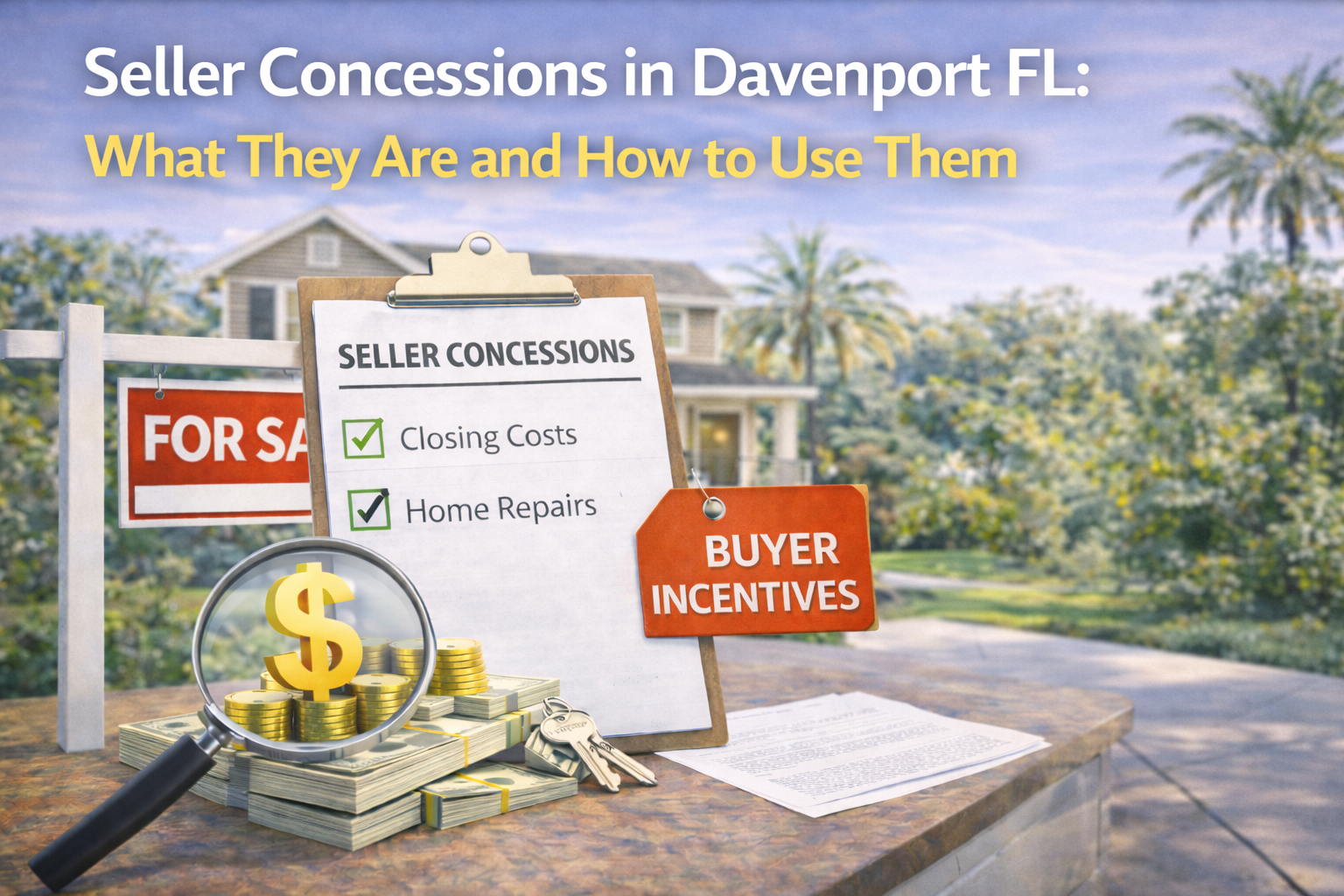
Seller Concessions in Davenport, FL: Sell Smarter

Seller Concessions in Davenport, FL: Sell Smarter
Published by Manny Barrios | Davenport FL REALTOR | 2MannyHomes.com
If you are getting ready to sell your home in Davenport, Florida, there is a good chance someone has already mentioned seller concessions to you. Maybe your agent brought it up. Maybe you saw it in a contract and were not sure what it meant. Either way, this is one of the most misunderstood tools in a seller's arsenal, and getting it wrong can cost you thousands of dollars at the closing table.
Seller concessions are not a sign of weakness. When used correctly, they are a strategic move that helps you sell faster, attract stronger buyers, and walk away with more money than you would have by holding the line on a number that the market does not support.
If you want to know what your home is worth before you decide how to structure your sale, request a free professional home valuation here and get a clear baseline before any negotiation starts.
What Are Seller Concessions in Real Estate?
Seller concessions are costs that the seller agrees to cover on behalf of the buyer at closing. Instead of the buyer paying those costs out of pocket, the seller either credits the buyer directly or absorbs specific line items as part of the deal.
The most common forms of seller concessions in the Davenport, FL market include closing cost credits, mortgage rate buydowns, prepaid property taxes or HOA fees, and repair credits following a home inspection. Each one works differently and serves a different strategic purpose depending on where you are in the negotiation and what is motivating your buyer.
Understanding the difference between these tools and knowing when to use each one is what separates a seller who nets maximum equity from one who gives money away unnecessarily or loses a deal by being too rigid.
Why Seller Concessions Have Become More Common in Davenport FL
The shift toward seller concessions in the Central Florida real estate market is directly tied to where interest rates have been over the past two years. When rates climbed significantly from their historic lows, buyer purchasing power dropped. A buyer who qualified for a $380,000 home at three percent suddenly qualified for substantially less at seven percent. That math changed the entire landscape of what buyers need to make a deal work.
Rather than simply lowering the list price, sellers who understand the market started offering concessions that addressed the buyer's actual problem, which in most cases was monthly payment affordability rather than purchase price. A rate buydown paid for by the seller can reduce a buyer's monthly payment by hundreds of dollars, making a home that otherwise felt out of reach suddenly very attractive.
This is why you are seeing concessions in more Davenport transactions today than you would have seen three or four years ago. It is not a sign of a weak market. It is a reflection of sellers adapting their strategy to match what buyers actually need.
You can see how this dynamic plays out in the broader market context in the Davenport FL Market Update March 2026, which breaks down current buyer behavior and inventory trends across Polk County.
The Most Common Types of Seller Concessions in Davenport FL
Closing Cost Credits
This is the most straightforward concession. The seller agrees to credit the buyer a specific dollar amount toward their closing costs at settlement. For a buyer who is stretching to cover a down payment, getting $8,000 to $12,000 in closing costs covered by the seller can be the difference between moving forward and walking away.
From the seller's perspective, this is a reduction in your net proceeds, but it is a targeted reduction that solves a specific problem for the buyer rather than a blanket price cut that reduces your headline number and affects how your listing is perceived.
Mortgage Rate Buydowns
A rate buydown is when the seller pays points at closing to reduce the buyer's interest rate, either permanently or for a fixed period. A two-one buydown, for example, reduces the buyer's rate by two points in year one and one point in year two before settling at the note rate in year three.
For buyers who are on the fence about affordability, this kind of concession is often more compelling than a price reduction because it directly lowers their monthly payment in the near term. It is also one of the most effective tools in the Davenport market right now for sellers competing against new construction builders who offer buydown incentives as a standard part of their sales model.
To understand how rate buydowns work from a buyer's perspective and why they are so effective at closing deals, read Beyond the Price Tag: Interest Rate Buydowns and Closing Credits Explained.
Repair Credits
After a home inspection, buyers often come back with a repair request list. Rather than completing the repairs yourself, which takes time and introduces contractor coordination into your closing timeline, you can offer a repair credit instead. The buyer receives a dollar amount at closing that they can apply toward repairs after they take ownership.
This keeps the deal moving, avoids the risk of repair quality disputes, and gives the buyer flexibility to use a contractor of their own choosing. For sellers in the Davenport market who are selling a home that is not fully updated or that has deferred maintenance, a repair credit negotiated cleanly is often the smoothest path to the closing table.
Prepaid HOA and Property Taxes
In communities with active HOAs, sellers sometimes offer to prepay a portion of HOA dues or cover the prorated property tax balance as part of the deal. This is a smaller concession in dollar terms but can have a meaningful psychological effect on buyers who are calculating the true cost of ownership in their first months.
How Seller Concessions Affect Your Net Proceeds
This is the number that actually matters, and it is where a lot of sellers get confused. A concession is not the same as a price reduction, but it does reduce what you walk away with. Understanding that relationship clearly is how you make smart decisions at the negotiating table.
Here is a simple way to think about it. If your home is listed at $375,000 and you accept an offer at $375,000 with a $10,000 closing cost credit, your effective net is $365,000 before other closing costs. If you had instead reduced the price to $365,000 with no concession, the buyer ends up in the same position but your headline sale price is lower, which affects comparable sales data for your neighbors and for your own appraisal.
Structuring a concession rather than a price cut can preserve your sale price on paper while still getting the deal done. That matters for the appraisal process and for the broader market data in your neighborhood.
Use the home sale calculator to run your numbers before you negotiate. Knowing your baseline net before you get into a concession conversation keeps you in control of the outcome.
When Should You Offer Seller Concessions?
Not every transaction requires a concession, and offering one when you do not need to is simply leaving money on the table. Here is how to think about when concessions make strategic sense in the Davenport market.
When your home has been sitting on the market and you have already made at least one price reduction, a concession can be more effective than another cut because it addresses buyer hesitation in a targeted way rather than signaling distress.
When you are competing with new construction, builders in the Davenport and Champions Gate corridor routinely offer rate buydowns and closing cost credits as part of their sales incentives. If your resale home is not offering anything comparable, you are asking buyers to choose your home at full price against a new build with financing perks. That is a difficult ask in the current market.
When a buyer is qualified but cash-constrained, meaning they have the income and the credit to support the purchase but are short on liquid funds for closing costs, a concession closes the gap without requiring a price negotiation that could anchor future counters lower.
When inspection findings create a leverage point, offering a clean repair credit rather than getting into a back-and-forth about what gets fixed and by whom keeps the deal on track and gives you control over the dollar amount rather than the scope of work.
For more on how pricing decisions and concession strategy interact, Should You Price High or Price to Sell in Davenport, FL? walks through the tradeoffs in detail.
When Seller Concessions Are the Wrong Move
There are situations where offering concessions too early or too generously works against you. If you are receiving multiple offers in the first week of listing, you are in a strong negotiating position and concessions should not be part of your opening strategy. Let the market tell you what it needs before you start giving things away.
If a buyer is asking for concessions on top of a price that is already at the low end of your acceptable range, you are compressing your net from both directions. In that scenario, holding on price and limiting concessions, or countering with a higher price that absorbs the concession, is often the stronger play.
A skilled listing agent in Davenport, FL knows how to read which lever to pull based on the specific buyer, the offer structure, and where you are in your timeline. That judgment is part of what you are paying for in professional representation.
Concessions vs. Price Reductions: Which One Wins?
This is a question that comes up in almost every negotiation in the current Davenport market, and the answer depends on your specific situation. But here is the general principle.
A price reduction is visible to every buyer who sees your listing. It signals that the market has spoken and you have responded, which can invite further negotiation. A concession is deal-specific and does not change your list price or your sale price on record. It is a private negotiation between you and a buyer who is already engaged.
If you are still in the active listing phase and trying to generate more showings, a price adjustment may be necessary. If you have an offer on the table and the gap is in closing costs or rate affordability rather than purchase price, a targeted concession is almost always the cleaner solution.
The goal in either case is to protect your net proceeds while giving the buyer what they need to move forward confidently. Those two things are not mutually exclusive when you are working with an experienced REALTOR who knows how to structure the deal.
📌 Know Your Numbers Before You Negotiate
Before you agree to any concession, you need to know exactly what your home is worth and what your net looks like at various price and concession combinations. Request your free home valuation at 2MannyHomes.com and get the real number so you can negotiate from a position of strength.
You can also connect directly at 2mannyhomes.com/connect to talk through your specific situation before you list.
Frequently Asked Questions
What are seller concessions in Florida real estate? Seller concessions are costs the seller agrees to cover on the buyer's behalf at closing. Common examples in the Davenport, FL market include closing cost credits, mortgage rate buydowns, repair credits, and prepaid HOA or property tax amounts. They are a negotiating tool that allows sellers to address buyer affordability concerns without necessarily reducing the list price.
Do seller concessions hurt the seller in Davenport, FL? Not when used strategically. A concession reduces your net proceeds by the agreed amount, but it can also be the difference between closing a deal and losing a buyer who was qualified but cash-constrained. The key is knowing how much concession is appropriate given your price, your market position, and your competition. Working with a local listing agent gives you the context to make that call correctly.
How much in seller concessions is typical in Davenport, FL? Concession amounts vary by price range and loan type. Conventional loans cap seller concessions at three to nine percent of the purchase price depending on down payment. FHA and VA loans have their own limits. In the current Davenport market, closing cost credits in the range of $5,000 to $15,000 and rate buydown contributions of one to two points are both common depending on the price point and buyer profile.
Is a seller concession the same as lowering the price? No, and the difference matters. A price reduction changes your list and sale price on public record, which affects comparable sales data for future appraisals in your neighborhood. A concession is a deal-specific credit that keeps your sale price intact while reducing your net proceeds. In many situations, a concession is a more precise and less damaging tool than a price cut.
Should I offer concessions upfront or wait for the buyer to ask? This depends on your market position. If your home is well-priced and generating strong interest, wait for the buyer to ask. If you are competing against new construction with builder incentives or your listing has been sitting for more than 30 days, proactively offering a concession in your listing or as part of an initial counter can accelerate buyer engagement and reduce the negotiation runway.
|


or another way